She Tried to Sell a Necklace… But the Jeweler Turned Pale When He Opened It
The rain was falling so heavily that night that the entire street looked like it was melting behind the jewelry shop window.
Cars passed slowly through the storm. Their headlights stretched across the wet road in long, broken lines. Water ran down the glass in silver streams, blurring the world outside until everything looked distant and unreal.
Inside the little jewelry shop, it was warm and quiet.
Soft amber lights glowed above the glass display cases. Gold rings, bracelets, and watches rested neatly on dark velvet. The air smelled faintly of old wood, metal polish, and rain-soaked air whenever the door opened.
But that evening, no customers had come in for nearly an hour.
The old jeweler sat behind the counter, bent over a small repair tray, adjusting the clasp of a bracelet with careful, tired hands. His name was Elias Ward. He had owned the shop for more than thirty years.
People in the neighborhood knew him as a quiet man.
Polite. Honest. Always serious.
But they also knew there was a sadness in him that never fully left.
Some said it began after his wife died. Others knew the truth was older than that.
Twenty years earlier, his little daughter Clara had disappeared on a rainy afternoon.
She had been six years old.
One moment, she was walking home with her mother.
The next, she was gone.
There had been police. Search teams. Posters. News reports. False sightings. Phone calls in the middle of the night. Hope that rose and collapsed again and again until there was almost nothing left of the man Elias used to be.
They never found her.
Not her coat.
Not her shoes.
Not the small gold locket he had placed around her neck on her sixth birthday.
For years, Elias had kept the shop open because he did not know what else to do with himself. He repaired other people’s rings. Polished other people’s memories. Sold gifts for weddings, anniversaries, birthdays, and apologies.
All while the one thing he wanted most in the world remained missing.
That night, as the rain battered the window, Elias lowered his tools and rubbed his eyes.
He was about to close.
Then the door flew open.
Cold wind burst into the shop, carrying rain with it. The bell above the door rang sharply, almost angrily.
Elias looked up.
A young woman stood in the doorway.
She was soaked from head to toe. Her dark hoodie clung to her shoulders. Her ripped jeans dripped water onto the tile floor. Her hair was wet and stuck to her face, and her chest rose and fell quickly, as if she had been running for a long time.
For a moment, she did not speak.
She only stood there, gripping something tightly in both hands.
Elias rose slowly from his stool.
“Can I help you?” he asked.
The young woman stepped inside and pushed the door closed behind her. The warmth of the shop surrounded her, but she looked like someone who no longer trusted warmth.
Her eyes moved quickly over the display cases, the counter, the old man behind it.
Then she walked toward him.
In her hands was a gold necklace with a round locket.
She placed it on the glass counter.
“How much will you give me for this necklace?” she asked.
Her voice was flat. Empty. Like she had forced herself not to care.
Elias looked at her, then at the necklace.
It was old. Scratched. But real gold.
He picked it up carefully.
The moment his fingers touched it, something strange moved through him. Not recognition. Not yet. Just a small discomfort, like a memory waking in a dark room.
He examined the chain under the light.
“I can give you fifty dollars,” he said. “Not more.”
The young woman answered too quickly.
“Okay. Deal.”
Elias looked up.
That told him everything.
She was not bargaining. She was not selling because she wanted to. She needed money immediately.
He studied her face again.
She could not have been more than twenty-five. Maybe younger. Her cheeks were pale from the cold. Her lips trembled slightly, though she tried to hide it.
“Are you sure?” Elias asked.
“Yes,” she said. “Please. Just give me the money.”
Her fingers tapped nervously against the counter.
Elias looked down at the locket again.
Something about it bothered him.
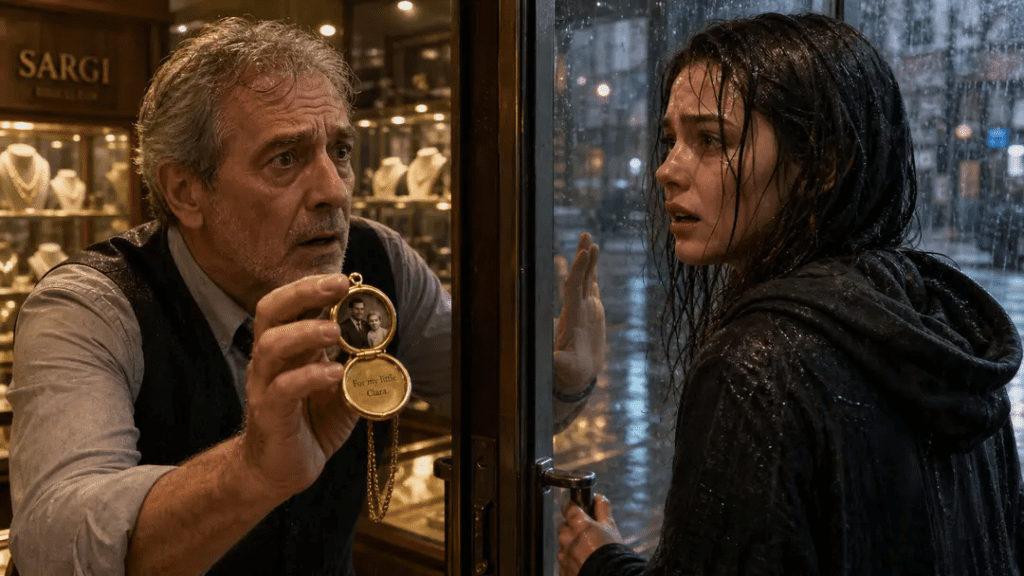
He turned it in his hand and noticed the tiny latch on the side. Without thinking much, he pressed it.
Click.
The locket opened.
Inside was a tiny black-and-white photograph.
A younger man.
And a little girl in his arms.
Below it, engraved in small worn letters, were five words.
For my little Clara.
Elias stopped breathing.
The shop disappeared around him.
The rain. The lights. The counter. The young woman.
Everything went silent.
His hand began to shake.
The locket nearly slipped from his fingers.
His eyes moved from the engraving to the young woman, then back to the photograph.
The man in the picture was him.
Younger. Smiling. Alive in a way he had not been for twenty years.
And the little girl in his arms was Clara.
His Clara.
The young woman had already started turning away, pulling her hood up again, as if she wanted to leave before the shop became too warm, before anything inside her had a chance to break.
But Elias could not move.
Could not think.
Could not even blink.
Twenty years.
Twenty years of silence.
Twenty years of unanswered prayers.
And now the necklace he had clasped around his daughter’s neck with his own hands was lying open in his trembling palm.
The young woman reached for the door.
That movement snapped him back to life.
Elias rushed from behind the counter so quickly that his hip struck the edge of a display case. He barely felt it.
“Wait.”
She froze but did not turn around.
He held the open locket up between them.
His voice broke before the words came out.
“Where did you get this?”
The young woman’s hand tightened around the door handle.
“I don’t know,” she said.
Elias stepped closer.
“That necklace belongs to my daughter.”
The woman slowly turned her head.
Rain and tears were mixed together on her face.
“What?”
He swallowed hard.
“My daughter,” he said. “My missing daughter.”
The words seemed to strike her harder than the cold outside.
For a moment, she only stared at him.
Elias looked at her eyes.
At the shape of her mouth.
At the small scar near her eyebrow.
At something in her face that felt impossible and familiar at the same time.
His voice dropped to a whisper.
“Clara?”
The young woman’s eyes widened.
For the first time since she had entered the shop, she looked truly afraid.
“No,” she whispered. “My name is Anna.”
Elias’s chest tightened.
“Anna?”
“That’s what they called me.”
“They?”
She looked away.
“I don’t remember much.”
Elias did not move.
Outside, thunder rolled over the rooftops.
The young woman took one step back.
“I should go.”
“No,” Elias said quickly. “Please. Don’t go.”
Something in his voice stopped her.
It was not command. It was pain.
She looked down at the locket in his hand.
“I’ve had that necklace my whole life,” she said quietly. “At least… as long as I can remember.”
Elias felt his knees weaken.
“Who gave it to you?”
She shook her head.
“I don’t know. I was told not to ask questions.”
“Who told you that?”
The young woman hesitated.
Then her face changed.
Fear returned.
“I can’t talk about that.”
Elias stared at her.
“Please,” he said. “I have searched for my daughter for twenty years.”
Her lips parted, but no words came.
Elias turned the locket toward her, showing the photograph.
“This is me,” he said. “And this is Clara. My little girl.”
Anna stared at the picture.
At first, nothing happened.
Then her breathing changed.
Her eyes narrowed slightly, not from confusion, but from pain. As if something buried deep inside her had moved.
“I’ve seen that face before,” she whispered.
Elias stepped closer.
“Mine?”
She shook her head slowly.
“Mine.”
The room became still.
Anna raised a trembling hand toward the photograph. Her fingertips hovered above the image of the little girl.
“I used to dream about this,” she said. “A man holding me. Rain outside. A song playing somewhere.”
Elias’s eyes filled with tears.
“What song?”
Anna closed her eyes, searching a place inside herself she had spent years avoiding.
Then, softly, she hummed a few broken notes.
Elias covered his mouth.
It was the lullaby he used to sing to Clara when she was scared during storms.
The same song no one else knew.
His voice failed him.
Anna opened her eyes and saw his expression.
“What is happening?” she whispered.
Elias could barely speak.
“You were afraid of thunder,” he said. “I used to hold you by the window and sing that song until you fell asleep.”
Anna shook her head, but tears were already falling.
“No. No, that’s impossible.”
“You had a little blue coat,” Elias continued, his voice shaking. “Yellow buttons. You hated carrots. You called the moon a broken cookie.”
Anna’s face crumpled.
She took another step back, pressing one hand to her chest.
“Stop.”
“You had a birthmark,” Elias said, barely breathing now. “On your left shoulder. Shaped like a small leaf.”
Anna froze.
The color drained from her face.
For several seconds, she did not move.
Then slowly, very slowly, she pulled the collar of her wet hoodie away from her shoulder.
Elias saw it.
A small brown birthmark.
Like a leaf.
The locket fell from his hand onto the floor.
Anna stared at him.
He stared back.
Neither of them spoke.
The truth stood between them, too large and too painful to touch.
Then Elias whispered, “My God.”
Anna’s knees gave out.
He caught her before she hit the floor.
For one impossible second, she was in his arms again.
Not six years old.
Not the little girl from the photograph.
But still his child.
Still alive.
Anna began to sob, not softly, not beautifully, but like someone who had been holding her breath for her entire life.
Elias held her tighter.
“I looked for you,” he whispered. “I never stopped looking.”
She gripped his coat with both hands.
“I didn’t know,” she cried. “I didn’t know.”
They stayed there on the floor of the little jewelry shop while the rain kept falling outside.
After a long time, Elias helped her sit in the chair behind the counter. He wrapped an old wool coat around her shoulders and made tea with hands that still would not stop shaking.
Anna told him what little she remembered.
A woman had raised her for most of her childhood. Not a mother, exactly. More like someone who kept her hidden from the world.
They moved often.
Different towns. Different names. No school records that lasted long. No photographs on the walls.
Whenever Anna asked about her past, the woman became angry.
“You were unwanted,” she would say. “I saved you.”
But Anna had never believed her completely.
There had always been dreams.
Rain.
A warm shop.
A man’s voice singing.
A locket she was warned never to open.
When the woman died three months earlier, Anna was left with nothing but debts, an old bag of clothes, and the necklace.
That night, hungry and desperate, she had decided to sell it.
She had walked into the first jewelry shop she found.
Not knowing the shop had once belonged to her father.
Not knowing the man behind the counter had spent twenty years waiting for a miracle.
Elias listened without interrupting.
Every word hurt him.
Every detail built a bridge between the daughter he lost and the woman sitting before him.
When Anna finished, she looked ashamed.
“I was going to sell it,” she whispered.
Elias shook his head.
“You brought it home.”
She looked at him.
He picked the locket up from the floor, wiped it carefully with a cloth, and placed it in her palm.
“This was always yours.”
Anna stared at it.
“I don’t know how to be her,” she said.
Elias sat across from her.
“You don’t have to become the little girl I lost,” he said. “You are who you are now. I just want the chance to know you.”
Her eyes filled again.
“What if I can’t remember everything?”
“Then we begin with what you can remember.”
“And if I’m not what you hoped for?”
Elias gave a broken smile.
“You walked through that door alive. That is more than I ever dared to hope for.”
For the first time, Anna did not look toward the exit.
She looked around the shop.
At the amber lights.
At the glass cases.
At the rain moving down the windows.
At the old man in front of her who looked at her as if she was not a stranger, not a burden, not a mistake, but a miracle returned from the dark.
Later that night, Elias called the police.
Not because he needed proof before loving her.
But because the truth deserved to be uncovered.
There would be questions. Records. Tests. Names to find. A past to face.
But for that one night, none of it mattered more than the simple fact that she was there.
When the storm finally softened, Anna stood by the window with the locket around her neck.
Elias stood beside her.
For a while, they watched the rain in silence.
Then Anna whispered, “Did you really search for me all those years?”
Elias looked at her reflection in the glass.
“Every day.”
She swallowed hard.
“And you never gave up?”
His eyes filled with tears again.
“No,” he said. “A father does not stop being a father just because the world tells him to.”
Anna closed her eyes.
The words reached a place inside her that had been empty for too long.
Then, slowly, she leaned her head against his shoulder.
Elias did not move.
He was afraid that if he breathed too hard, the moment might disappear.
But it did not.
She stayed.
And outside the little jewelry shop, the rain kept falling.
Only now, it no longer sounded like something being lost.
It sounded like something being washed clean.
Morning came quietly.
The storm had passed during the night, leaving the streets washed clean, the air lighter, almost unfamiliar after so many hours of darkness. Pale sunlight slipped through the jewelry shop window, touching the glass cases, the velvet displays, the old wooden counter.
Anna woke slowly.
For a moment, she didn’t recognize where she was.
Then she felt it.
The locket, resting against her chest.
Her hand moved to it instinctively.
Memory rushed back.
The shop.
The man.
The name.
Clara.
She sat up quickly.
Across the room, Elias was already awake. He stood near the window, speaking quietly on the phone. His posture was tense, controlled, like a man holding himself together piece by piece.
When he turned and saw her awake, he ended the call.
“They’re coming,” he said softly.
Anna swallowed.
“The police?”
Elias nodded. “And a specialist. Missing persons cases… identity confirmation.”
She looked down.
“So now we find out if I’m really her.”
Elias stepped closer, but carefully, as if afraid to push too hard.
“For me,” he said gently, “I already know enough.”
Anna didn’t answer.
Because for her, it wasn’t that simple.
Knowing something in your heart… and proving it to the world… were not the same thing.
—
By midday, the shop was no longer quiet.
Two officers arrived first. Calm. Professional. Careful not to overwhelm.
They asked questions.
Names. Dates. Places.
Anna answered what she could.
There were gaps.
Too many gaps.
But there were also details she couldn’t explain.
A lullaby she had never been taught.
A memory of standing by a window during a storm.
A fear of thunder she had carried her entire life without knowing why.
Then came the specialist.
An older woman with kind eyes and a voice that didn’t rush.
She explained everything clearly.
Records would be checked.
Old case files reopened.
DNA testing arranged.
“It may take some time,” she said. “But we will find the truth.”
Anna nodded.
Time.
That word felt heavy.
Because for Elias, twenty years had already been too much.
—
The next days passed slowly.
Anna stayed in the apartment above the shop.
Elias insisted.
Not out of obligation.
But because neither of them was ready to let the other disappear again.
They moved carefully around each other at first.
Like strangers who shared something too big to name.
Breakfasts were quiet.
Short conversations.
Long pauses.
But little by little, something began to change.
It started with small things.
Anna noticing how Elias always checked the door lock twice before sleeping.
Elias noticing how Anna avoided loud noises, especially thunder, even when it was far away.
One evening, as rain began again—soft this time, nothing like before—Anna froze near the window.
Elias saw it immediately.
Without a word, he moved closer.
And very quietly… he hummed.
The same melody.
The same lullaby.
Anna didn’t turn.
But her shoulders slowly relaxed.
After a moment, she whispered, “I know that song.”
Elias’s voice almost broke.
“I know.”
That night, something shifted.
Not completely.
But enough.
—
A week later, the call came.
Elias answered it with shaking hands.
Anna stood across the room, watching him, her heart pounding so loudly she thought it might drown out the words.
He listened.
Didn’t speak.
Didn’t move.
Then slowly… he closed his eyes.
When he finally lowered the phone, there were tears on his face.
Anna couldn’t breathe.
“What did they say?”
Elias looked at her.
Not with doubt.
Not with fear.
But with certainty.
“They confirmed it.”
Silence filled the room.
“You’re my daughter.”
Anna didn’t react immediately.
Because some truths are too big to feel all at once.
Then it hit her.
Not like a wave.
Like something unlocking inside her.
Years of confusion.
Of not belonging.
Of questions without answers.
They didn’t disappear.
But they finally had a place to go.
Her knees weakened.
Elias moved instantly, catching her again, just like the night before.
This time, she didn’t hesitate.
She held onto him.
Tightly.
As if letting go would mean losing everything again.
“I don’t remember everything,” she said through tears.
“You don’t have to,” Elias whispered. “We’ll remember together.”
—
The investigation didn’t end there.
The woman who had raised Anna was no longer alive, but her past was uncovered piece by piece.
Records revealed she had once worked near the neighborhood where Clara disappeared.
Witnesses remembered seeing her around that time.
What began as suspicion became truth.
Clara had been taken.
Hidden.
Given a new name.
A new life built on silence.
It wasn’t a story of kindness.
It was a story of control.
But Anna had survived it.
And now, she was no longer alone inside it.
—
Months passed.
The jewelry shop changed.
Not in how it looked.
But in how it felt.
Laughter returned.
Not constant.
Not perfect.
But real.
Anna began working there, slowly learning the craft.
At first, her hands shook when she held delicate pieces.
Elias guided her patiently.
“Steady,” he would say. “Jewelry teaches you how to slow down.”
She smiled once.
A small, uncertain smile.
But it stayed.
Customers began to notice.
The quiet shop with the serious owner now had something warmer in it.
Something alive.
—
One evening, as the sun set and painted the sky in soft gold, Anna stood by the window again.
Elias joined her.
For a while, they said nothing.
Then Anna touched the locket around her neck.
“I almost sold this,” she said.
Elias looked at it.
“And instead, it brought you back.”
She turned to him.
“Do you ever think about… what would have happened if I chose a different shop?”
Elias exhaled slowly.
“I used to think about all the things that went wrong,” he said. “Every mistake. Every moment I wished I could change.”
He paused.
“But now?”
He looked at her.
“I think about the one thing that went right.”
Anna’s eyes filled again.
Not with pain this time.
With something softer.
“Me walking through that door.”
Elias nodded.
“Yes.”
She leaned her head gently against his shoulder.
This time, there was no hesitation.
No fear.
Just presence.
Outside, the street was calm.
No storm.
No rushing footsteps.
Just quiet life moving forward.
And inside the little jewelry shop, under warm amber lights, a father and daughter stood together—not as strangers connected by the past, but as two people building something new.
Not what was lost.
But what was found.
And for the first time in twenty years, the story didn’t feel unfinished.
It felt like a beginning.